Fathom catches silent failures in
Data + AI code across pull requests, repositories, and API workflows.
Coming soon, building with evidence
will help people and coding agents work with intent, context, and
evidence from the start.
Mitari is building verification infrastructure for Data + AI development.
Fathom verifies changes today. A new
layer, coming soon, carries intent and evidence upstream — so
Fathom can verify before code ever
reaches a pull request, not just after.
Mitari — verification infrastructure for Data + AI
Build with evidenceComing soon
People and agents work with explicit intent, durable context, evaluations, and supporting evidence.
Passes the change and evidence forward
passes the change, context, and evidence to
FathomAvailable now
Independently verifies the change, surrounding logic, and available evidence before it ships.
Verifies Data + AI code independently
Proof
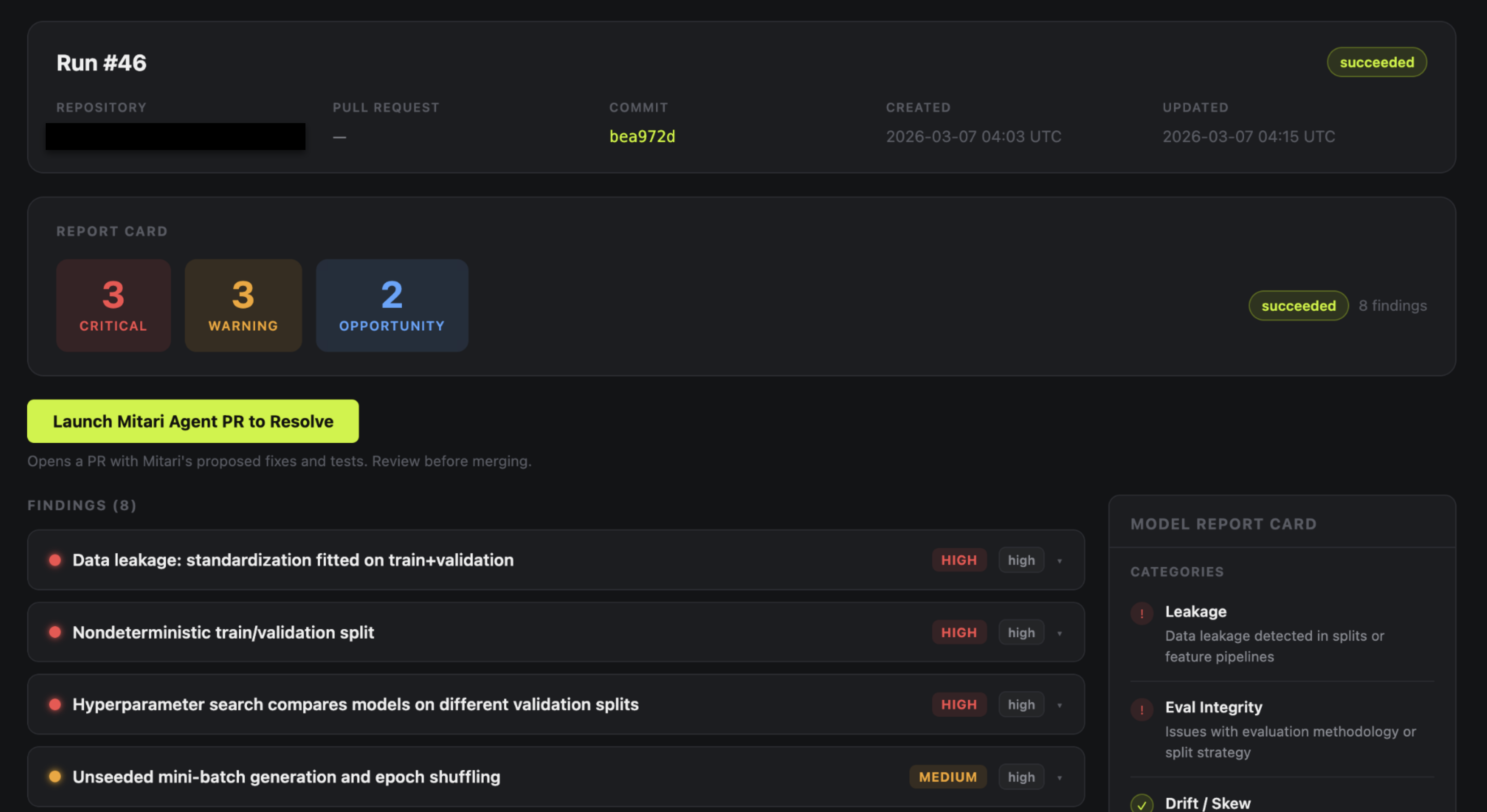
See a real Fathom verification
A public repository, a real pull request, and a visible commit — with
actual Fathom findings. The query runs without error, but the resulting
training data is invalid. Fathom catches what tests and ordinary review
let through.
How Paai uses Mitari for partner-discovery verification
Paai uses Mitari as a specialized verification layer for data operations
and partner-discovery logic, helping catch subtle filtering and
methodological issues during review before they reach production.
From pull-request verification to repository-wide analysis, targeted fix
branches, and an API for local files — Fathom covers the full verification
loop for Data + AI teams.
Pull Request Verification
Catch Data + AI bugs before they merge, as GitHub Checks with inline annotations.
GitHub Checks
Inline annotations
Diff vs existing split
Repository Verification
Map issue patterns across repos and files, clustered by severity and ranked by Fathom score.
Repo-level visibility
File-level Fathom
Watchlist alerts
Targeted Fix PRs
Turn selected findings into targeted fix branches, bounded by semantic and syntax checks.
Selected findings
Semantic checks
Fix-blocked safety
API and Agent Workflows
Call Fathom from scripts, CI, or agentic workflows — submit local files and poll results.
Submit local files
Poll results
API keys · 100/hour
How the verification loop works
Where Fathom fits in the lifecycle
Fathom is the independent verification step in how Data + AI systems get
built — from intent through to what teams learn after shipping.
Purple · Fathom — Available now
Green · Build with evidence — Coming soon
Build with evidence — Coming soon
IntentDefine what should be true.
BuildA person or coding agent creates the change.
EvaluateTests, harnesses, and existing tools produce evidence.
ShipApproved changes move forward.
LearnOutcomes improve future development and verification.
↓
Fathom verifiesFathom independently judges the change, context, and available evidence.Fathom — Available now
↓
Inside the Fathom verification step
Connect a change
Install the GitHub App, select a repository, or submit SQL or Python through the API.
Fathom builds context
Fathom analyzes the change, surrounding logic, and relevant Data + AI failure patterns.
Fathom verifies
Findings explain what may be wrong, why it matters, and what evidence supports the judgment.
Review, fix, and re-verify
Resolve the finding manually or open a targeted fix PR and verify the resulting change again.
↓
Build with evidence — Coming soon
Verification should not begin at the pull request.
Today, Fathom independently verifies changes during review and across
existing codebases. Mitari’s next product will bring structure to the
surrounding lifecycle—helping people and agents define intent, build
with durable context, connect evaluation evidence, and carry what teams
learn back into future development.
Together, the two layers connect creation and evidence with independent
verification.